
Key Takeaways
- Logistics Alignment: Bridging the gap between global shipping protocols and digital data transmission.
- Academic Standards: Understanding the specific technical rigours of Canadian post-secondary institutions.
- Technical Authority: Applying advanced networking formulas to troubleshoot remote lab environments.
- Strategic Support: Leveraging professional mentorship to navigate complex Canadian academic rubrics.
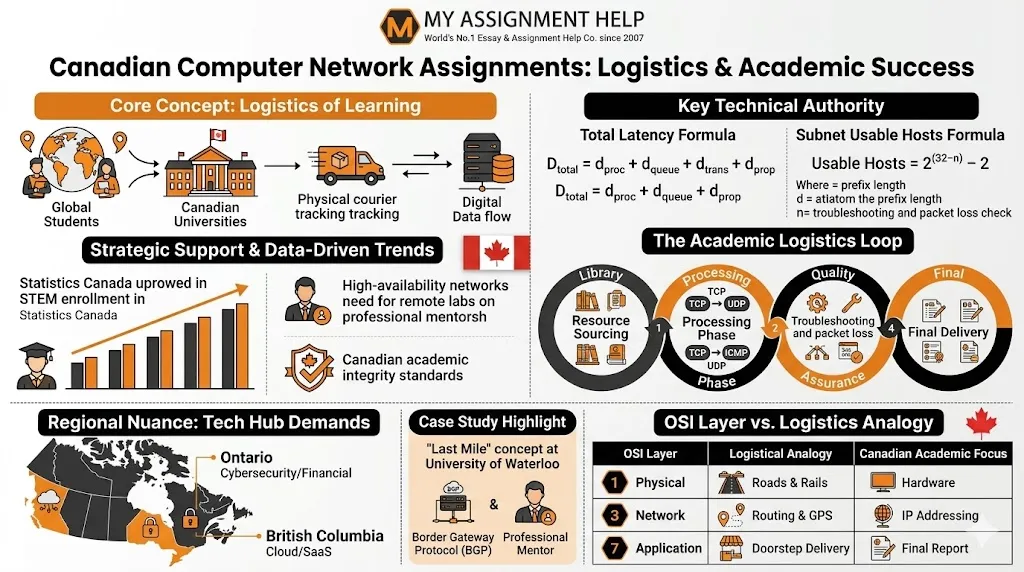
The contemporary educational landscape has undergone a transformative shift, increasingly resembling the sophisticated structures of the global logistics industry. Just as a courier service utilizes an intricate network of nodes, hubs, and optimized routes to ensure a parcel reaches a doorstep in Toronto or Vancouver, the modern international student must manage a complex “digital supply chain” of information. This “logistics of learning” is especially pronounced for those moving to Canada, where academic success depends on the seamless synchronization of technology, time management, and institutional standards.
Successfully navigating this journey requires more than just academic talent; it demands a strategic allocation of resources. As students integrate into various provinces—from the burgeoning tech sectors of Ontario to the research-heavy environments of Quebec—the pressure to maintain high GPAs while adapting to local standards is immense. Many high-achieving scholars find that the most effective way to remain competitive is to seek professional assistance to do my assignment in Canada, ensuring they meet local rubrics while balancing the demands of physical relocation with the necessity of high-calibre academic output.
This logistical challenge is perhaps most visible in the field of Information Technology and Systems Architecture. In a world where the economy runs on stable digital infrastructure, the ability to design and troubleshoot networks is a foundational skill. Consequently, many students seek out specialized computer network assignments help to master the advanced routing tables, subnetting logic, and security frameworks that keep the world’s actual courier tracking systems operational. The intersection of physical logistics and digital networking is no longer a theory; it is the backbone of the Canadian labour market.
Technical Challenges in Canadian Computer Network Assignments
In a Canadian academic context, the “logistics” of a networking assignment involve managing latency, packet loss, and server uptime. For a student in Calgary connecting to a university lab in Montreal, the mathematical reality of network delay can be summarized by the total latency formula:
D_{total} = d_{proc} + d_{queue} + d_{trans} + d_{prop}
Beyond simple latency, students must also master the efficiency of their network designs. For instance, calculating the number of usable hosts in a specific subnet is a core requirement for assignments involving IPv4 architecture. This is determined by the formula:
Usable\ Hosts = 2^{(32-n)} – 2
(Where ‘n’ represents the prefix length or CIDR mask). Mastering these calculations is essential for clearing the technical hurdles that frequently appear in advanced networking simulations.
The Academic Logistics Loop
- Resource Sourcing: Identifying high-authority Canadian scholarly references and establishing project baselines.
- Processing Phase: Executing networking protocols like TCP, UDP, and ICMP within complex lab environments.
- Quality Assurance: Implementing troubleshooting steps to eliminate packet loss and ensure system stability.
- Final Delivery: Reviewing technical reports against specific institutional rubrics and Canadian academic integrity standards.
Data-Driven Trends in Canadian Tech Education
Recent data from Statistics Canada highlights a significant uptick in international students enrolling in Computer Science and Engineering programmes. This influx has led to a greater demand for robust remote lab infrastructures. Universities across the country are now prioritizing “high-availability” networks to ensure that the digital delivery of education is as reliable as a priority shipment.
Logistics and Layering Comparison
| OSI Layer | Logistical Analogy | Canadian Academic Focus |
| Layer 1: Physical | Roads & Rail Tracks | Hardware availability and ISP reliability |
| Layer 3: Network | Routing & GPS | IP Addressing, Subnetting, and OSPF configurations |
| Layer 7: Application | Doorstep Delivery | Final report presentation and technical viability |
Regional Nuance: Tech Hub Demands Across Canada
The “logistics of learning” vary significantly depending on the province and the specific tech ecosystem a student is targeting for their future career.
Ontario’s Financial and Cybersecurity Corridor
In the Greater Toronto Area (GTA) and Ottawa, the academic focus is heavily skewed toward network security and data integrity. Students here often face assignments focused on financial-grade encryption and high-redundancy network designs. The logistical challenge involves maintaining uptime for critical services while navigating the stringent compliance standards expected in the Canadian financial sector.
British Columbia’s Cloud and SaaS Ecosystem
Conversely, in Vancouver and Victoria, the curriculum often prioritizes cloud architecture and software-defined networking (SDN). Students at institutions like the University of British Columbia (UBC) deal with the logistics of large-scale data centres and distributed systems. The challenge here is managing “elasticity”—the ability to scale network resources up or down—mimicking the rapid delivery cycles of the West Coast tech industry.
Case Study: Navigating the “Last Mile” at the University of Waterloo
A student perspective from the University of Waterloo illustrates the intensity of these technical logistics. Known for its rigorous co-op programmes, Waterloo requires students to transition rapidly from theoretical classroom logic to professional-grade network troubleshooting. One student noted that the “last mile” of their final project involved configuring a complex Border Gateway Protocol (BGP) setup that mirrored a real-world ISP exchange. By utilizing professional academic mentorship, the student was able to identify a single misconfigured Autonomous System (AS) number that would have caused a total project failure, ensuring their submission met the high standards of the university.
Frequently Asked Questions (FAQ)
Q1: Why is network subnetting so difficult for new students in Canada?
It requires a high degree of mathematical precision and binary logic that is often not emphasized in general IT courses, making it a common “bottleneck” in the logistics of learning.
Q2: How do remote labs help in mastering computer networking?
Remote labs allow students to interact with real hardware (switches/routers) or simulations like Packet Tracer from anywhere in Canada, providing the hands-on experience needed for the job market.
Q3: Is professional academic support common for tech students?
Yes, many students use professional guidance to bridge the gap between abstract textbook theory and the rigorous technical standards expected by Canadian employers and professors.
About the Author
Jordan M. is a Senior Content Strategist and Academic Consultant at MyAssignmentHelp. With extensive experience in the Canadian education sector and a background in Information Technology, Jordan specializes in developing resources that help international students succeed in complex STEM environments. Jordan’s work focuses on bridging the gap between technical complexity and academic clarity.
References & Sources
- Statistics Canada (2024). Trends in International Student Enrollment in STEM.
- Cisco Networking Academy. The Role of Simulation in Remote Technical Education.
- Canadian Journal of Higher Education. Digital Infrastructure and Student Performance.